Family and Friend Poems
FamilyFriendPoems.com - Poetry exploring the dynamics of Family, Friends & Relationships.
Home Submit
Poems
Family
Poems
Friendship
Poems
Forums

Articles on Poetry

Back to Articles

The Elements of Poetry

Richard M. Deets

Poetry, as an art form, predates literacy. In pre-literate societies, people frequently employed poetry as a means of recording oral history, storytelling, genealogy, law, and other forms of expression or knowledge that modern societies record in prose. Compared with prose, poetry depends less on the linguistic units of sentences and paragraphs, and more on units of organization that are purely poetic.

In the European tradition, the earliest surviving poems, the Homeric and Hesiodic epics, identify themselves as poems to be recited or chanted using the poem's rhythm, refrains, and kennings as essentially paratactic devices that enabled the reciter to reconstruct a poem from memory.

The introduction of writing tended to fix the content of a poem to the version that happened to be written down at the time and survived. Written composition also meant that poets began to compose not for an audience that was sitting in front of them, but for an absent reader. Later, the invention of printing tended to accelerate these trends. Poets were now writing more for the eye than for the ear.

The word poetry comes from the Greek word, poieo, which means, "I create." Poetry uses language for its aesthetic qualities in addition to its notional and semantic content. Poets often use condensed or compressed form to convey emotion or ideas to the reader's mind or listener's ear.

Today's high school students are the beneficiaries of poetic techniques developed over the past several millennia by cultures throughout the world. They use devices such as assonance, alliteration, enjambment, parallelism, dissonance, internal rhyme, and repetition to achieve poetic and musical effects. Additionally, poems frequently rely on imagery, rhetorical devices such as simile and metaphor, tension between the use of linguistic and formal units, and units of sound.

Perhaps the most vital element of sound in poetry is rhythm. Formalist poets arrange the rhythm of each line in a particular meter. Different types of meter played key roles in Classical, Early European, Eastern, and Modern poetry. In the case of free verse, the poet organizes rhythm of lines into looser units of cadence.

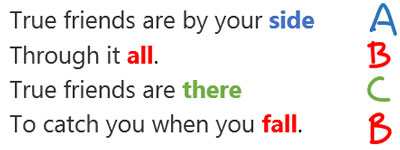
Another unit of sound, rhyme at the end of a line is the basis of several common poetic forms such as ballads, sonnets, and rhyming couplets. However, the use of rhyme is not universal; much modern poetry avoids traditional rhyme schemes.

High school students learn that interactively layering all these effects to generate meaning is what marks poetry. In most poetry, it is the connotations and the weight of words that are most important. These shades and nuances of meaning can be difficult to interpret and can cause different readers to hear or understand a particular piece of poetry differently. While there are reasonable interpretations, there can never be a definitive interpretation.

In more recent times, the introduction of electronic media and the rise of poetry readings has led to a resurgence of performance poetry. The late 20th-century rise of the singer-songwriter, Hip-Hop and Rap cultures has ushered in an increase in popularity of Slam poetry.

Slam performers compete in local, state and national teams with an emphasis on political and social ills, opening a renewed debate as to the nature of poetry, as well as a split between the academic and popular points of view.

What academia generally accepts as "great" poetry is debatable in many cases. "Great" poetry usually follows the aforementioned characteristics, set apart by its complexity and sophistication. "Great" poetry generally captures images vividly in an original, refreshing way, while weaving together an intricate combination of elements like theme, tension, complex emotion, and profound reflective thought.

The high school student, who is serious about developing his or her poetic voice, will develop a rich working vocabulary and critically read hundreds of "great" poems of various epochs and cultures, as well as the Works of diverse critics.

Through gaining an understanding of these masters' works and cultivating one's observational eyes and ears, the student embarks on a dynamic journey rich in creativity, imagination and reflection.

Back to Articles

Our Favorites:  Best Friend Poems  Anniversary Poems  Baby Poems  Birthday Poems  Missing You Poems  Im Sorry Poems  Friend Poems 

About Us |  Blog  |  Contact Us |  Privacy Policy |  Advertise |  Link to us |  FAQ
Add us as A Friend on: MySpace or Facebook

The copyright of all poems on this website belong to the individual authors.
All other material on this website is
Copyright 2006 - 2008 by Family Friend Poems.com